

Uganda’s capital Kampala has on Tuesday November 16 been rocked with two explosions in the Central Business District.
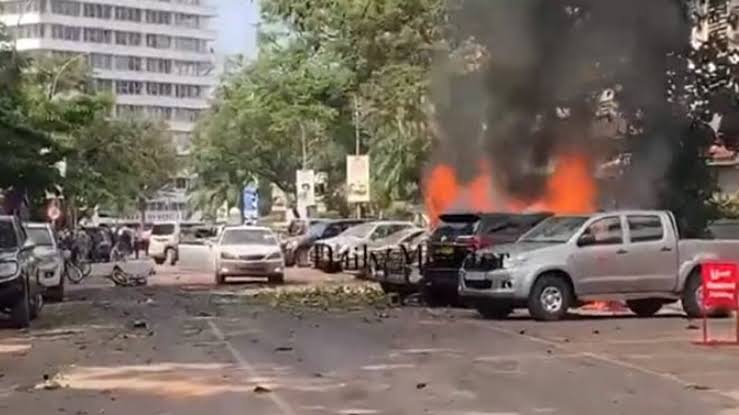
Photos and videos shared on social media showed heavy clouds of smoke and some cars burning near Jubilee Insurance along Parliamentary Avenue.
Parliament has been sealed off by security.
Some lawmakers were seen evacuating the precincts of the parliamentary building nearby.
Another explosion was reported at Kooki towers, opposite Central Police Station in Kampala.
Reports say that several people have been injured.
An eyewitness video posted online showed a plume of white smoke rising from the blast scene near the police station.
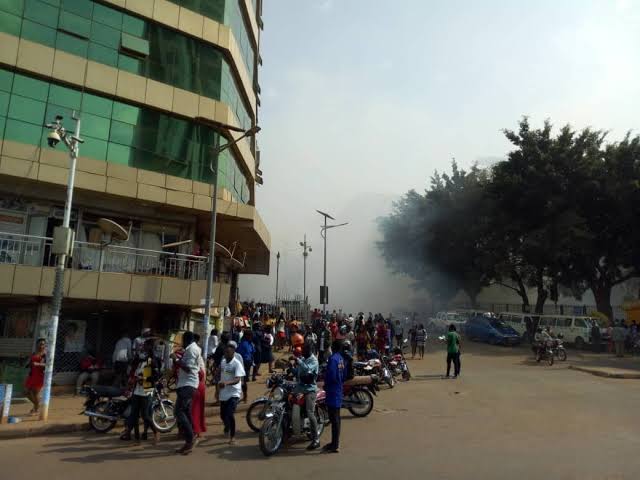
Police did not immediately comment, and it was not clear if the explosions were bomb attacks. There was no immediate word on casualties.
People are scampering to leave the city, many on passenger motorcycles.
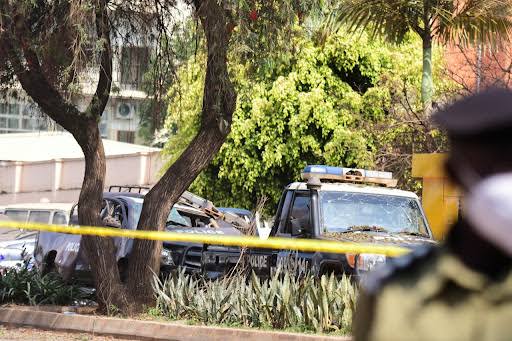
Ugandan officials have been urging vigilance in the wake of a string of bomb explosions in recent weeks.
One person was killed and at least seven others wounded in an explosion at a restaurant in a suburb of Kampala on Oct. 23.
Another explosion two days later on a passenger bus killed only the suicide bomber, according to police.
Even before those attacks, the U.K. government had updated its Uganda travel advisory to say extremists “are very likely to try to carry out attacks” in this East African country.
The Allied Democratic Forces, an affiliate of the Islamic State group in central Africa, claimed responsibility for the attack on the eatery.
That group has long been opposed to the rule of longtime President Yoweri Museveni, a U.S. security ally who was the first African leader to deploy peacekeepers in Somalia to protect the federal government from the extremist group al-Shabab. In retaliation over Uganda’s deployment of troops to Somalia, the group carried out attacks in 2010 that killed at least 70 people who had assembled in public places in Kampala to watch a World Cup soccer game.

But the Allied Democratic Forces, with its local roots, has proved more of a headache to Museveni.
The group was established in the early 1990s by Ugandan Muslims who said they had been sidelined by Museveni’s policies. At the time, the rebel group staged deadly terrorist attacks in Ugandan villages as well as in the capital, including a 1998 attack in which 80 students were massacred in a frontier town near the Congo border.
A Ugandan military assault later forced the rebels into eastern Congo, where many rebel groups are able to roam free because the central government has limited control there.
Reports of an alliance between the Allied Democratic Forces and the Islamic State Group first emerged in 2019, according to the SITE Intelligence Group, which tracks the online activities of extremist organizations.
Story being Updated
|A Free Press|
P.O.Box 612 Gulu, Uganda







 Alexi McCammond
 Brooklyn Amber
 Francis Oyet
 Isaac Erick Odongo
 Janna Jihad
 Admin
Admin Andrew Ogwang
 Samson Kasumba
 Song Moo-Bin (송무빈)
 TwalibZaitunk
 The Northern Press