


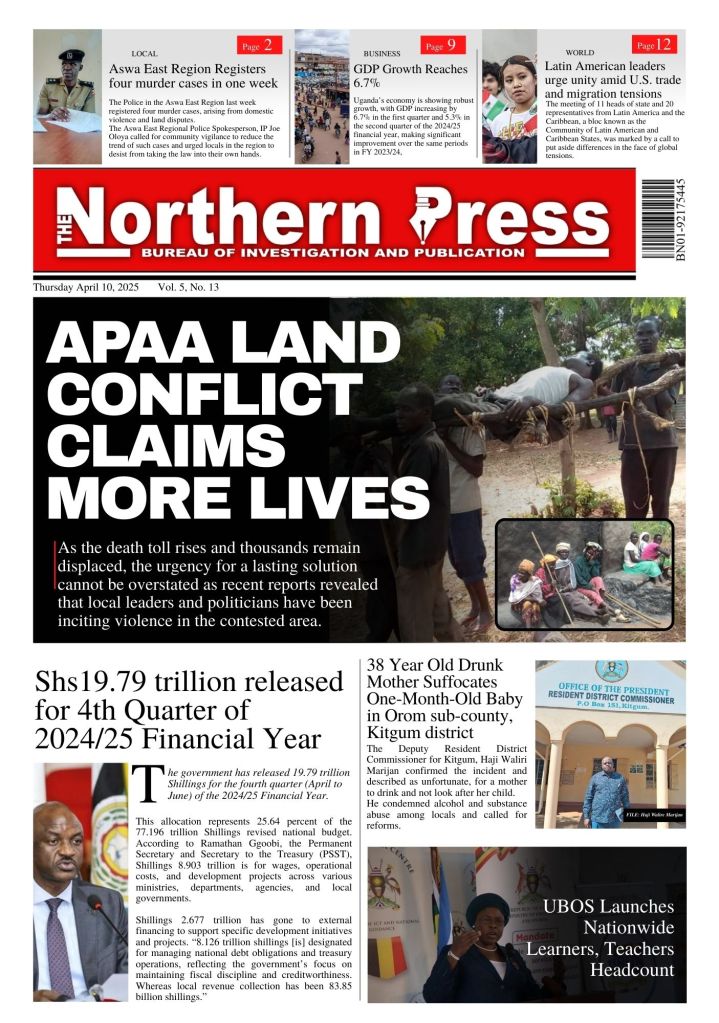
Apaa, Uganda – The Apaa land conflict, a decades-long dispute between the Acholi and Madi communities in northern Uganda, continues to claim lives, displace thousands, and deepen ethnic divisions, with no resolution in sight despite years of government interventions and local mediation efforts.
The contested region, straddling Amuru and Adjumani districts, has become a flashpoint for violence, leaving residents in a state of perpetual fear and uncertainty as historical grievances, colonial legacies, and government inaction fuel the crisis.
A History of Contention
The roots of the Apaa land conflict stretch back to 1911, when the British colonial government forcibly displaced residents to combat tsetse flies. The area, part of a sprawling elephant corridor rich in wildlife, was later designated a nature reserve, with boundaries marked by stone features known as “Galayas” among the Acholi.
This colonial policy disregarded the customary land ownership of both the Acholi and Madi communities, setting the stage for a century of disputes.
The conflict escalated after Uganda’s independence in 1962, when the government gazetted Apaa as part of the East Madi Wildlife Reserve in 2002, a decision locals claim was made without their consultation.
Residents argue that the wildlife reserve no longer exists, and they accuse the Adjumani district local council of overstepping its jurisdiction by offering the land to the government for conservation purposes.
The boundary between Amuru (predominantly Acholi) and Adjumani (predominantly Madi) remains contested, with both communities claiming historical ownership. A mediation meeting of ancestral Acholi and Madi elders once agreed that the Zuka Bridge marked the boundary, but this agreement has not been honored, leading to repeated clashes.

Recent Violence and Loss of Life
The Apaa land conflict has claimed numerous lives over the years, with violence often involving machetes, arrows, and other weapons. A 2018 clash at Gorobi River, reported by Monitor, saw Acholi leaders’ efforts to claim Apaa repelled by the Madi, resulting in several deaths. In 2023, the Uganda People’s Defence Force (UPDF) ordered the eviction of 40,000 illegal settlers from Apaa following tribal clashes, displacing over 10,000 people. Despite these interventions, the violence persists.
Recent reports indicate that the death toll continues to rise. Survivors of past clashes, like Olyel, who was attacked with a machete in 2017, have recounted the brutality of the violence, with four killed and 27 injured in that incident alone, according to The Observer. The ongoing skirmishes have left families shattered, with many residents fleeing their homes to seek safety in neighboring areas or makeshift camps.
The lack of security has also stalled development in Apaa parish, with schools and health centers, such as the abandoned Apaa Health Centre II, remaining closed due to the conflict.
Root Causes of the Crisis
Several factors contribute to the persistence of the Apaa land conflict:
Unresolved Land Ownership: The Acholi claim Apaa as part of Amuru district, while the Madi assert it belongs to Adjumani, a dispute rooted in colonial-era boundaries. The government’s failure to clearly demarcate these boundaries has fueled tensions, with both communities feeling their ancestral rights are under threat.
Government Policies and Inaction: Residents accuse the government of prioritizing wildlife conservation over their livelihoods by gazetting the land for the Uganda Wildlife Authority (UWA). A 2022 Monitor report revealed that local leaders and politicians have been inciting violence, undermining the role of cultural leaders who traditionally promoted harmony. The report also noted that the jurisdictional dispute has led to a near-total collapse of service delivery, affecting an estimated 35,000 residents in Apaa and the nearby Zoka area.
Historical Grievances: The colonial displacement of 1911 created a legacy of distrust, which successive governments have failed to address. The post-LRA insurgency period (after 2006) further complicated the situation, as returning Acholi found the Madi asserting control over the land, backed by some Adjumani leaders.
Resource Competition: Apaa’s fertile land and natural resources are vital for the livelihoods of both communities, making control over the area a matter of survival. This competition, coupled with poverty and underdevelopment, has intensified the conflict.
Failed Interventions and Growing Frustrations
Efforts to resolve the Apaa land conflict have been numerous but largely unsuccessful. In 2020, President Yoweri Museveni proposed three potential solutions: relocating Apaa residents to Acholi land with compensation, allowing them to remain without further expansion, or resettling them on government-acquired land. However, these proposals were met with resistance.
A 2021 Real Muloodi News Network report noted that Madi leaders rejected Museveni’s directives, demanding a neutral team to verify the situation and criticizing the government for engaging only Acholi leaders in the process.
The UPDF has also been involved, with an officer reading submissions from both communities on March 10, 2025. Yet, the government’s heavy-handed approach, including UWA’s attempts to evict residents despite a court injunction, has eroded trust.
A 2022 government report admitted that delayed action and incitement by self-centered politicians have escalated the clashes, further complicating resolution efforts.
Humanitarian and Social Impact
The Apaa land conflict has had a devastating impact on the local population:
Loss of Lives and Injuries: The violence has resulted in numerous deaths and injuries, with survivors often requiring extensive medical treatment. The 2017 clash alone left 27 people injured, many in critical condition.
Displacement: Over 10,000 people have been displaced since 2023, with many living in makeshift camps or fleeing to neighboring areas. This displacement has disrupted education, farming, and access to basic services.
Economic Stagnation: The conflict has stalled development in Apaa, leaving the region economically marginalized. The closure of health centers and schools has further compounded the suffering of residents.
Social Division: The rift between the Acholi and Madi has deepened, fostering mistrust and animosity. Cultural differences, as highlighted in a Lexology analysis, have complicated mediation efforts, with both communities feeling their identities and historical claims are under threat.

Voices from the Ground
Jevice Atunya Onek, a 76-year-old opinion leader in Apaa trading centre, told The Northern Press Bureau of Investigation and Publication, “This land is our ancestral home. The government cannot turn it into a nature reserve without consulting us. We have nowhere else to go.” His sentiments echo the frustration of many residents who feel abandoned by the state.
Akol, a national leader quoted in Monitor, expressed concern about the suffering of both communities, noting that many are selling their land at low prices out of fear of losing it to non-natives. “We are all Ugandans, whether Acholi or Madi. We must find a way to coexist,” he said, echoing a call for unity that has yet to materialize.
A Path Forward?
To end the Apaa land conflict and prevent further loss of life, a multi-faceted approach is urgently needed:
Clear Boundary Demarcation: The government must use satellite imagery and colonial maps to establish clear boundaries, ensuring both communities are involved in the process to avoid perceptions of bias.
Culturally Sensitive Mediation: Mediators must be trained to navigate the cultural differences between the Acholi and Madi, involving local elders to rebuild trust and address historical grievances.
Community Dialogue: Grassroots dialogue facilitated by neutral parties can help foster coexistence and reduce tensions.
Development Initiatives: Investing in schools, health centers, and infrastructure can reduce competition over resources and give both communities a stake in peace.
Addressing Historical Injustices: The government should acknowledge the colonial-era displacements and consider reparative measures like land restitution or compensation.
A Call for Action
The Apaa land conflict is a stark reminder of how historical injustices, government inaction, and cultural divides can fuel deadly violence. As the death toll rises and thousands remain displaced, the urgency for a lasting solution cannot be overstated.
The Acholi and Madi communities, despite their differences, share a common identity as Ugandans.
It is time for leaders at all levels—government, cultural, and local—to rise above the conflict and work toward a future where Apaa is no longer synonymous with bloodshed, but with peace and coexistence.







 Alexi McCammond
 Brooklyn Amber
 Francis Oyet
 Isaac Erick Odongo
 Janna Jihad
 Admin
Admin Andrew Ogwang
 Samson Kasumba
 Song Moo-Bin (송무빈)
 TwalibZaitunk
 The Northern Press