

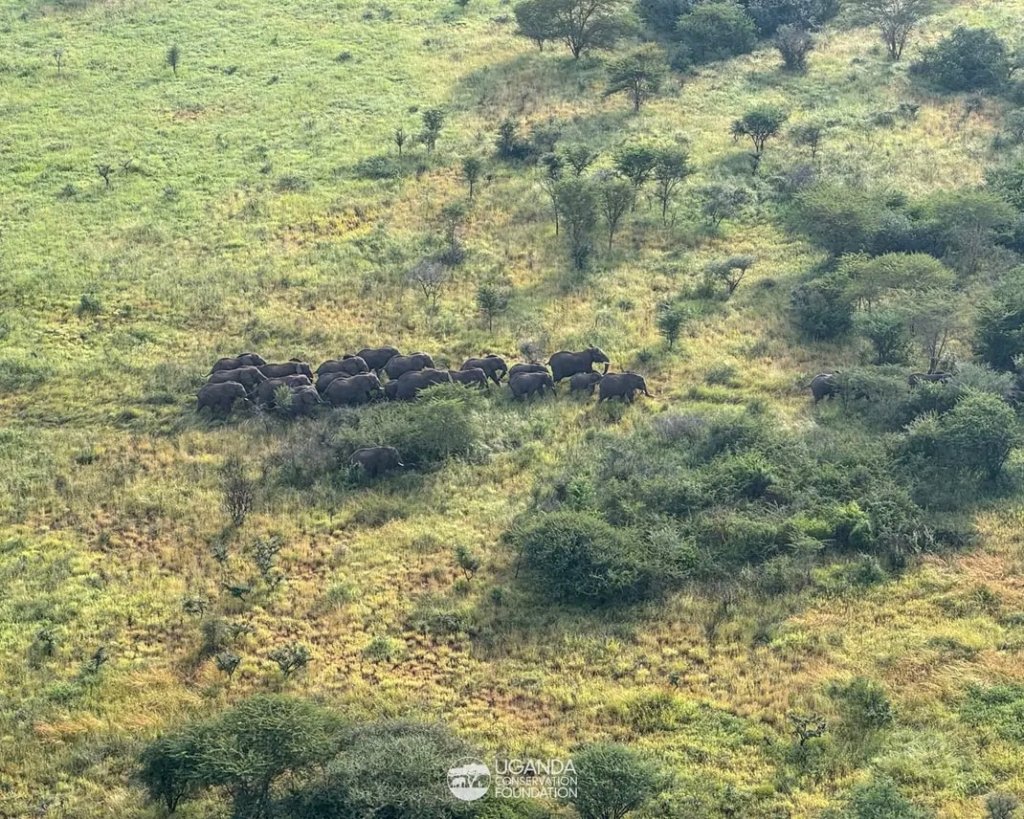
Nwoya, Uganda | August 7, 2025 – Farmers in Nwoya District are reeling from significant losses after a recent invasion by stray elephants from Murchison Falls National Park.
The marauding elephants have trampled and consumed acres of vital crops, including maize, soybeans, and cassava, threatening the livelihoods of local communities and raising fears of food insecurity.
The destruction, reported across several sub-counties including Koch Goma, Anaka, and Purongo, has left farmers devastated. According to local reports, over 1,000 acres of farmland have been ravaged in the past month alone, with entire fields of maize flattened, soybean crops uprooted, and cassava plantations decimated. The affected villages, such as Ceke and Agung, are among the hardest hit, with some farmers losing their entire harvests.
“We are helpless,” said Lucy Obuko, a small-scale farmer in Ceke Village, who lost four acres of maize to the elephants. “Our men stay up all night guarding the fields, but the elephants are too many and too strong. We are staring at hunger.” Obuko’s sentiments echo the frustration of many in Nwoya, where agriculture is the backbone of the local economy.
The influx of elephants is attributed to their search for food, driven by the fertile lands outside the park’s boundaries. Emmanuel Orach, the Nwoya District Chairperson, noted that the human-wildlife conflict has escalated since new settlers began cultivating crops like maize and soybeans, which are highly palatable to elephants. “These crops attract the elephants, and without proper barriers, they keep coming,” Orach said. He reported that since October 2023, elephants have destroyed an estimated 5,000 acres of crops and caused 13 fatalities in the district.
Local leaders and farmers have accused the Uganda Wildlife Authority (UWA) of failing to address the crisis effectively. David Ogwang, the LC1 Chairperson of Bunyama Village in neighboring Kiryandongo, described the situation as “uncontrollable,” claiming that UWA has ignored repeated pleas for intervention. “We need electric fences and compensation for our losses. The government must act now,” he urged.
In response, Wilson Kagoro, UWA’s Conservation Education Officer for Murchison Falls National Park, stated that teams are engaging with affected communities. “We are on the ground, assessing the damage and working on solutions,” Kagoro said. He highlighted ongoing efforts to extend electric fencing, with 44 kilometers already installed in Nwoya since 2022, though termites and maintenance issues have reduced its effectiveness. UWA has also introduced concrete poles to replace wooden ones to improve the fencing’s durability.
The UWA has established a Shs2 billion compensation fund, with Shs900 million disbursed by August 2024 to cover crop losses, including maize, soybeans, and rice, with payments ranging from Shs50,000 to Shs30 million based on market value. However, Orach alleges that only three compensation cases from Nwoya have been processed, leaving many farmers without relief. “The process is too slow, and many lack the documentation needed,” he said.
Farmers have resorted to traditional deterrents like banging metallic pots, planting chili peppers, and using beehives, but these methods have proven largely ineffective against the determined elephants. Adok Santa, a 52-year-old farmer from Koch Goma, has spent months sleeping in a makeshift shelter in her millet garden to protect it. “We risk our lives every night, but we have no choice. Without our crops, we have nothing,” she said.
The crisis has sparked protests, with farmers in neighboring Buliisa District storming sub-county headquarters on July 20, 2024, demanding government action. Similar demonstrations occurred in Kiryandongo, where over 10 acres of banana plantations, beans, and cassava were destroyed in Bunyama Village. Residents are calling for a comprehensive response, including faster compensation and a fully fenced park boundary.
The UWA, in partnership with organizations like the Uganda Conservation Foundation, is exploring innovative solutions such as wildlife-friendly agriculture and satellite tracking of elephants to monitor their movements. However, with only 35 kilometers of the park’s boundary left unfenced, Orach emphasized that completing the electric fence is the only permanent solution. “We cannot keep living like this,” he said.
As the human-wildlife conflict intensifies, the people of Nwoya face an uncertain future. With their crops destroyed and livelihoods at stake, they are urging the government and UWA to act swiftly to prevent further losses and restore hope to their communities.








 Alexi McCammond
 Brooklyn Amber
 Francis Oyet
 Isaac Erick Odongo
 Janna Jihad
 Admin
Admin Andrew Ogwang
 Samson Kasumba
 Song Moo-Bin (송무빈)
 TwalibZaitunk
 The Northern Press