

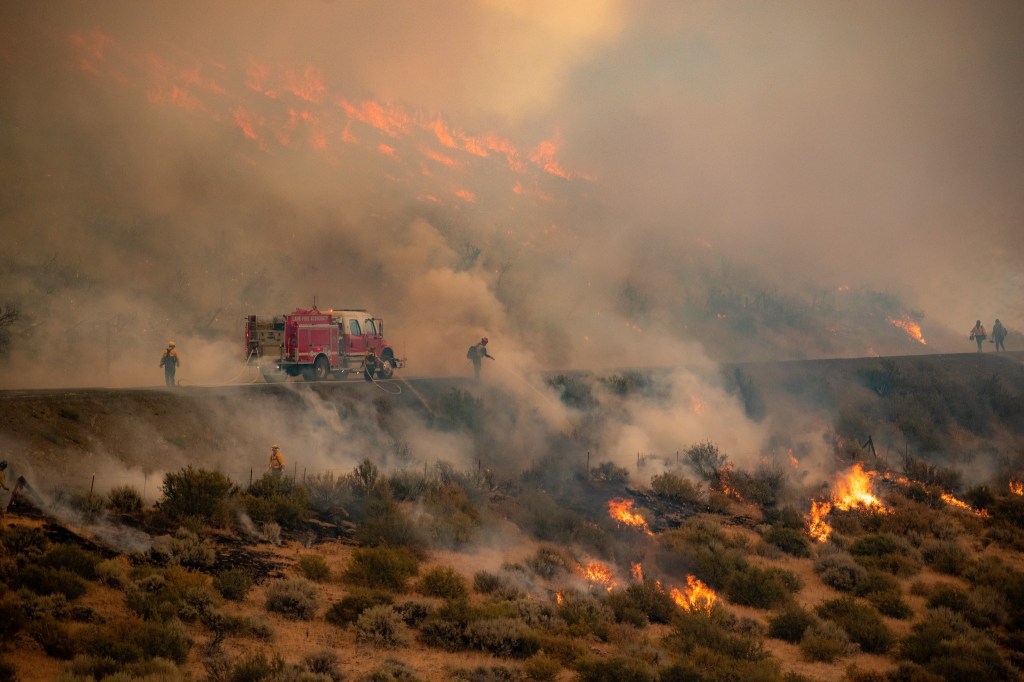
Aude, France | August 7, 2025 – France is grappling with its most devastating wildfire in decades, which has scorched over 16,000 hectares (39,537 acres) in the Corbières massif, Aude department, leaving a trail of destruction across 15 communes.
The blaze, which erupted on Tuesday, August 5, 2025, amid prolonged heat and drought, has claimed at least one life, injured 13 people, and left three others missing, according to local authorities. The fire, described as the largest in France since 1949, remains uncontained despite the efforts of over 2,100 firefighters and water-bombing aircraft.
The fire began near the village of Ribaute at around 4:15 p.m. on Tuesday, fueled by dry vegetation, strong Tramontane winds reaching 60 km/h, and weeks of scorching temperatures. Spreading at an alarming rate—burning 7,000 hectares in just seven hours—it has devastated pine forests, vineyards, and garrigue in the Corbières hills, a region renowned for its medieval villages and wine production. By Wednesday evening, the fire had consumed an area one-and-a-half times the size of Paris, leaving a blackened landscape of charred trees and ash.
One woman, a 65-year-old resident of Saint-Laurent-de-la-Cabrerisse, was found dead in her home after refusing to evacuate, according to local officials. Thirteen others, including 11 firefighters, have been injured, with one civilian hospitalized for serious burns and one firefighter treated for a head injury. Three people remain missing, and authorities are working to locate them. At least 36 homes have been destroyed or damaged, alongside 35 vehicles, with small villages like Villesèque-des-Corbières and Jonquières suffering severe losses. “It’s a lunar landscape, everything is burned,” said Jacques Piraux, mayor of Jonquières, where over half the village was reduced to ash.

French Prime Minister François Bayrou, who visited the affected area alongside Interior Minister Bruno Retailleau, described the blaze as “a catastrophe of unprecedented scale,” attributing its intensity to climate change and prolonged drought. “What is happening today is linked to the changing climate and the extreme dryness of the vegetation,” Bayrou told reporters. The fire’s rapid spread, with a 30km-long fire front at its peak, has been called the most violent and fastest-moving in France this century.
Over 2,100 firefighters, supported by 500 fire engines and a fleet of water-bombing aircraft, including Canadair planes, Dash aircraft, and helicopters, have been deployed to combat the blaze. Despite a slight drop in temperatures and weaker winds overnight, the fire remains uncontained, with flames looping back toward Ribaute and advancing into denser, less accessible parts of the Corbières massif. “The rear of the fire has become the front,” said Colonel Christophe Magny, head of the Aude fire department, noting the challenges posed by mountainous terrain and thick vegetation.
Evacuations have been widespread, with residents of villages such as Lagrasse, Fabrezan, Tournissan, and Coustouge forced to flee. Temporary shelters have been established in 17 municipalities to accommodate those displaced, while others have been advised to stay indoors unless ordered to evacuate. The A9 motorway, a major route between France and Spain, has reopened, but several smaller roads remain closed, disrupting travel in the region.
The Aude prefecture has launched an investigation to determine the fire’s cause, with authorities exploring possibilities such as a discarded cigarette butt or other human activity, as 90% of wildfires in France are linked to human causes, intentional or otherwise. Specialist detectives are analyzing the scene and may trace mobile phone data to identify potential sources.

Local residents and officials are grappling with the emotional and environmental toll. “It’s heartbreaking to see our Corbières region reduced to ash,” said Xavier de Volontat, mayor of Saint-Laurent-de-la-Cabrerisse. “The landscapes, the wildlife, the homes—it will take years to rebuild.” Aude Damesin, a resident of Fabrezan, echoed the sentiment: “It’s tragic for the flora, the wildlife, and the people who’ve lost everything.” The fire has also raised concerns about the region’s tourism and wine industries, with vineyards and medieval villages among the hardest hit.
The blaze is part of a broader wave of wildfires across southern Europe this summer, driven by climate change-induced heat and dryness. France has recorded over 9,000 fires since June, burning nearly 24,000 hectares nationwide, with the Aude fire alone matching the total damage of all previous blazes this season. Météo France reported that a sea breeze bringing more humid air may slow the fire’s spread, but the risk remains high in Aude, Pyrénées-Orientales, and Hérault, which are on the second-highest alert level for forest fires.
As firefighters continue their battle, the French government has pledged support for affected communities. Agnès Pannier-Runacher, France’s Minister for Ecological Transition, called the fire “the most significant since 1949,” urging collective action to address climate-driven disasters. With the blaze still active, authorities warn it could take days to bring under control, leaving the Corbières region and its residents facing an uncertain road to recovery.








 Alexi McCammond
 Brooklyn Amber
 Francis Oyet
 Isaac Erick Odongo
 Janna Jihad
 Admin
Admin Andrew Ogwang
 Samson Kasumba
 Song Moo-Bin (송무빈)
 TwalibZaitunk
 The Northern Press