

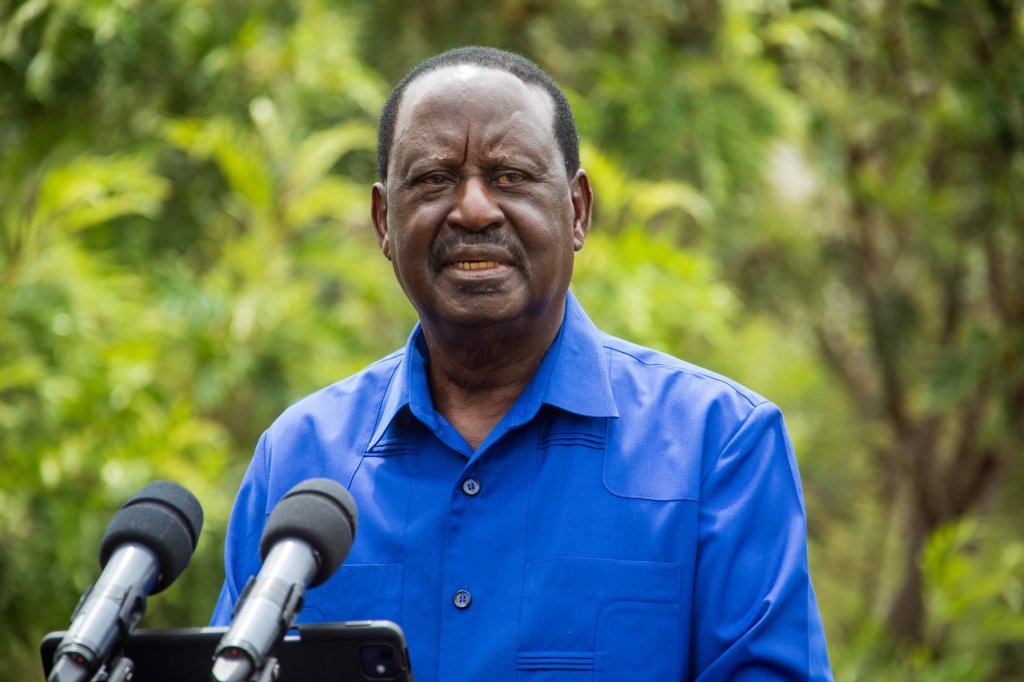
NAIROBI, Kenya — Raila Odinga, the indomitable force behind Kenya’s democratic struggles and a towering figure in African politics, has passed away at the age of 80.
The veteran opposition leader suffered a fatal cardiac arrest during a morning walk at an Ayurvedic eye hospital in Koothattukulam, Ernakulam district, Kerala, India, where he was seeking treatment. The news, confirmed by hospital authorities and Kenyan officials, has sent shockwaves through the nation, prompting an outpouring of grief and tributes from across the continent.
Odinga, affectionately known as “Baba” or “Agwambo” to his legions of supporters, collapsed around 9 a.m. local time on Wednesday. He had been visiting the Sreedhareeyam Ayurvedic Eye Hospital and Research Centre, a facility with personal significance to his family. His daughter, Rosemary Odinga, had undergone treatment there in 2017 after suffering optic nerve damage that left her blind. Despite immediate medical efforts, the 80-year-old succumbed to the sudden heart failure, marking the end of an era in Kenyan and pan-African politics.
Born on January 7, 1945, in Maseno, Kisumu District, to independence hero Jaramogi Oginga Odinga and Mary Juma Odinga, Raila Amolo Odinga inherited a legacy of activism and resilience. Educated in engineering in East Germany during the Cold War era, he returned to Kenya in the 1970s to join the family business, but his path quickly veered toward political firebrand. Imprisoned multiple times under President Daniel arap Moi’s one-party regime for his role in pushing for multiparty democracy, Odinga endured solitary confinement and torture, emerging each time as a sharper thorn in the side of autocracy.
His political journey was a rollercoaster of near-misses and landmark achievements. Odinga served as Kenya’s Prime Minister from 2008 to 2013 in a power-sharing government formed after the violent 2007 elections. He ran unsuccessfully for the presidency five times—in 1997, 2007, 2013, 2017, and 2022—often amid allegations of electoral fraud that tested the nation’s fragile institutions. Yet, his “handshake” pact with then-President Uhuru Kenyatta in 2018 helped de-escalate post-election tensions, paving the way for constitutional reforms and economic initiatives. More recently, Odinga vied for the chairmanship of the African Union Commission, losing narrowly to Mahmoud Ali Youssouf but solidifying his stature as a continental statesman and AU High Representative for Infrastructure Development.
Odinga’s influence extended far beyond Kenya’s borders. A vocal advocate for good governance, people-centered development, and regional integration, he was hailed by world leaders as a “global African” and “solution seeker.” Tanzanian President Samia Suluhu Hassan described his death as “a tragedy not just for Kenya, but for all of us,” praising his peace-loving spirit that resonated across East Africa. Indian Prime Minister Narendra Modi, who once shared a candid conversation with Odinga during a 2022 “Mann Ki Baat” address, extended condolences, recalling their mutual commitment to democratic values.
In Kenya, the response was swift and somber. President William Ruto, Odinga’s erstwhile rival turned ally, visited the Odinga family home in Nairobi’s upscale Karen suburb early Wednesday morning. Addressing the nation, Ruto declared seven days of national mourning and a state funeral, emphasizing Odinga’s role in forging the freedoms Kenyans cherish today. “He championed reforms that gave birth to the rights and freedoms we hold dear… His conviction inspired generations, and his vision shaped the course of our history,” Ruto said, a gesture aimed at quelling any potential unrest amid the country’s polarized politics.
Hundreds of supporters, many weeping and clutching twigs to ward off evil spirits in Luo tradition, gathered outside the home to pay respects. Social media erupted with hashtags like #RIPBaba and #RailaForever, as politicians from all sides—from Ruto’s United Democratic Alliance to Odinga’s own Orange Democratic Movement (ODM)—suspended campaigns to honor the man who redefined opposition in Africa.
Odinga leaves behind his wife, Ida Odinga, and three surviving children: Rosemary, Raila Jr., and Winnie. His eldest son, Fidel, predeceased him in 2015. A private family ceremony is expected in India before his body is repatriated to Kenya for the state funeral.
As Kenya pauses to reflect, Odinga’s legacy endures—not as a defeated perennial candidate, but as the architect of a more open, if imperfect, democracy. In the words of the African Union Commission head, he was “a steadfast champion of democracy,” whose voice will echo long after the mourning ends. For a man who spent decades fighting for his people’s tomorrow, today’s sorrow is laced with gratitude for the battles won.





 Alexi McCammond
 Brooklyn Amber
 Francis Oyet
 Isaac Erick Odongo
 Janna Jihad
 Admin
Admin Andrew Ogwang
 Samson Kasumba
 Song Moo-Bin (송무빈)
 TwalibZaitunk
 The Northern Press